Overview
Domain Driven Design (DDD) is a methodology initially defined in 2003 in Eric Evan’s popular and well-received book ‘Domain-Driven Design: Tackling Complexity in the Heart of Software’ [1]. It is aimed at decomposing the complexity of a Problem Space (that is, a business's functional domain/capabilities that are requiring development) into a domain model comprised of one or more Bounded Contexts; a set of cohesive, decoupled, suitably-sized and well-organised definitions of objects and business rules that may be understood by both business stakeholders and technical staff, to offer easier interpretation and design of software. These Bounded Contexts define the problem's Solution Space.
While DDD predates the advent of microservices by almost 10 years, its goals and defined patterns for designing cohesive, decoupled and collaborative bounded contexts are strongly aligned with microservice architecture goals, for implementing cohesive and decoupled services that realize advantages of change agility, resilience and scalability within cloud environments. As such, DDD has become a popular reference today when discussing microservice architectures within complex domains.
Domain-driven design is aimed at promoting design quality via the following methods:
A. Using Strategic Patterns to:
- Distil the Problem Space, i.e. an organisation's business capabilities, to identify features important to the business by:
- Using 'Knowledge Crunching' methods to extract relevant information and help identify and decompose the problem space into separate manageable subdomains.
- Defining a Shared/Ubiquitous Language (UL) for each subdomain that is understood by both business and technical stakeholders, which should subsequently be used for documentation and code artefacts (e.g. for the names of classes and their methods and attributes).
- Produce a Solution Space comprising Bounded Contexts to demarcate and model solutions for identified subdomains.
- Producing a Context Map that defines the relationships between bounded contexts.
For example (with credit to Millett & Tune [3]):
 Illustrating DDD Patterns for the Problem Space
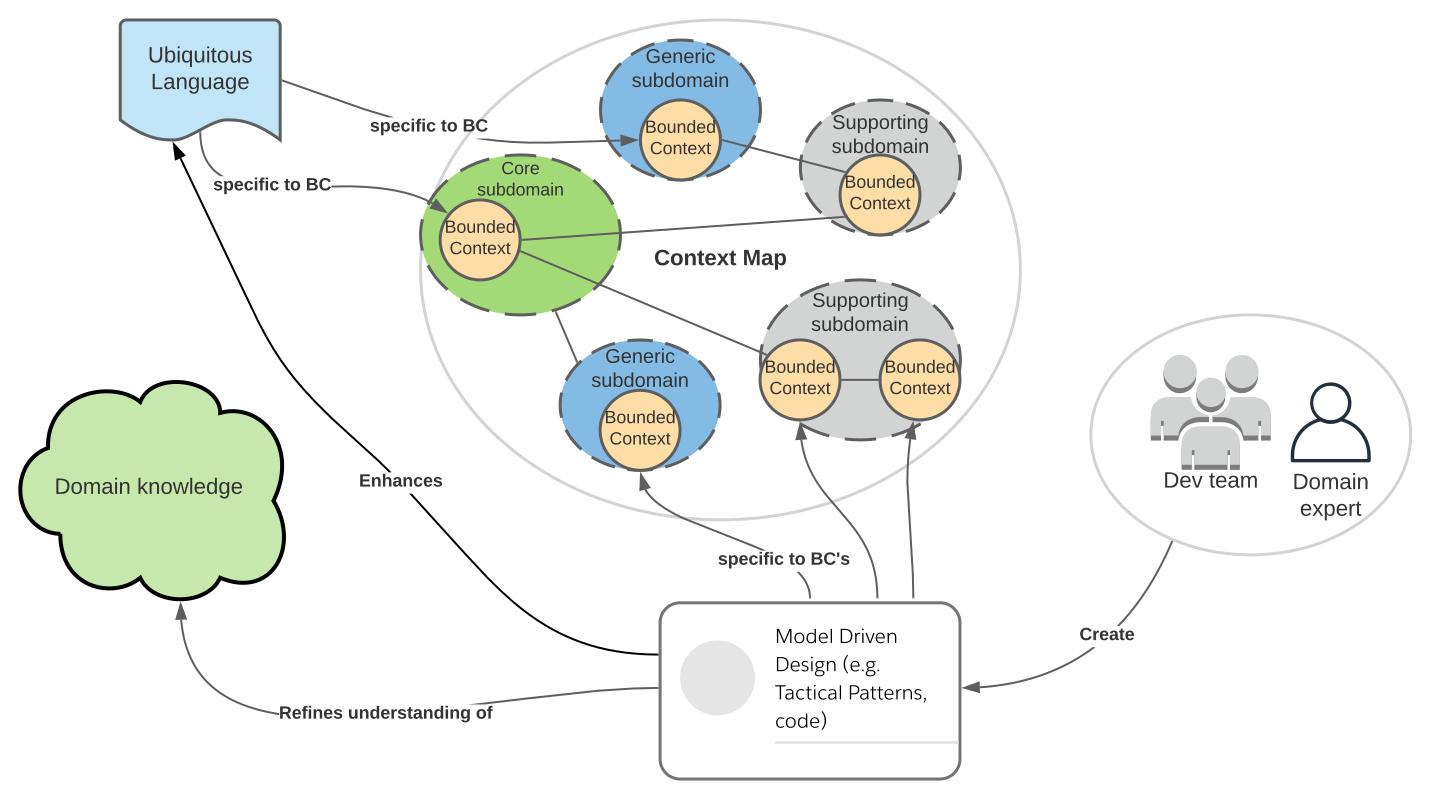 Illustrating DDD Patterns for the corresponding Solution Space
Refer to Strategic Patterns for examples used with The Better Store
B. Using Tactical Patterns to:
- Create an effective Object-Oriented domain model for each Bounded Context, using defined patterns such as Entity, Aggregate, Value Object, Service, Factory and Repository.
- Illustrate emerging patterns of domain events and event sourcing.
Refer to Tactical Patterns for examples used with The Better Store